
Home News & Blog CNC Trimming What does CNC stand for?

What does CNC stand for?

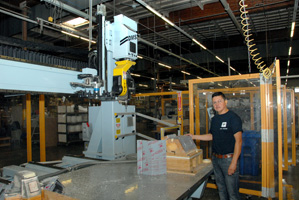
CNC means Computer Numerical Control. This means a computer converts the design produced by Computer Aided Design software (CAD), into numbers.

The numbers can be considered to be the coordinates of a graph and they control the movement of the cutter. In this way the computer controls the cutting and shaping of the material

HOW THE COORDINATES WORK

The way coordinates are used can be seen opposite. The X, Y and Z axis control the movement of the cutter on a 3D CNC machine. This allows materials to be machined in three directions (3D manufacture).
The plastic block shown below has been shaped on a CNC machine. It started as a cube.

The design (produced on CAD, Computer Aided Design software) has been converted into coordinates. The cutter is instructed to go from one coordinate to another. A simple plastic block such as this may have a thousand coordinates.

From:  technologystudent.com

Recent Articles

  • The New Regional Reality: Why OEMs Are Shifting Production to SoCal

    Tariff schedules have shifted enough over the past few years that a sourcing plan anchored to China can go stale within a single budget cycle, and more than a few OEMs have learned that the hard way. Shipping delays stretching a two-week lead time into two months don’t help, nor does a design question sitting…

    Read More

  • Defense Supply Chain Resiliency Starts with Defense-Compliant Partners

    Defense contractors don’t get the luxury of supply chain surprises. Supply chain failures in defense carry consequences that go well beyond a late shipment; contract performance and compliance exposure are never far behind. The margin for error is narrow, and the sourcing decisions made during planning often determine how a program performs under pressure. Defense…

    Read More

  • What Makes a Thermoforming Partner Ideal for Complex Aerospace Paint and Prep Projects?

    Aerospace paint and prep work must hold up under close scrutiny. A part may be formed to spec, trimmed cleanly, and ready for assembly, but the final surface still has to meet the customer’s cosmetic requirements. Gloss, clarity, coating consistency, and edge quality all matter, especially on large thermoformed aerospace parts with visible surfaces, contours,…

    Read More