Home News & Blog Blog Painting & Printing

Painting & Printing

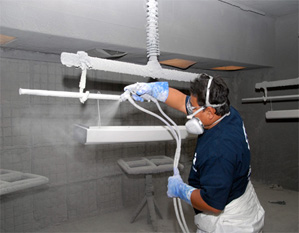
TFP’s in-house painting department provides a variety of applications using state-of-the-art equipment. Our painting experts use the latest techniques to apply the coating per your specifications. Special templates and fixtures are designed to cover parts over the areas that do not require paint. These detailed forms contour the required surfaces thus streamlining the prep and masking process.

Because of our commitment to EPA and AQMD regulations, TFP is one of the few painting houses permitted by the State of California to perform shielding applications with nickel and copper. In fact, TFP is UL approved and certified for application of said materials on certain substrates. While adhering to AQMD permissible standards for higher VOC’s, we encourage application of 1.0 VOC paints across all materials to promote GREEN.

TFP has developed and maintains a very close relationship with major paint suppliers. Due to these relationships, we are able to obtain immediate responses for color matching and a quick delivery of paint. We also have the ability to test in-house for color, gloss and surface resistivity to meet all your requirements.

TFP Excels In:

  • Application of various types of paint including water bourne & polyurethanes
  • Smooth Finishes
  • Surface Texturing
  • EMI Shielding
  • Specialty Masking and Fixturing
  • Peel off Protective Coating
  • Multi Color Silk Screening
  • Pad Printing
  • Sand Blasting

Recent Articles

  • Design for Manufacturability in Thermoforming: What Engineers Need to Know

    At Tru-Form Plastics, we believe successful thermoforming projects start well before a part reaches production. Bringing manufacturing expertise into the design process early can help customers avoid problems, find better ways to achieve their goals, and make informed decisions about materials, geometry, tooling, and assembly. Whether we’re developing a creative solution with an engineering team…

    Read More

  • Solving a Complex Assembly Challenge with an Aircraft Lavatory – Toilet Shroud

    The aircraft lavatory toilet shroud presented a problem that many thermoformers would not want to touch. The existing manufacturing method relied on drape forming, a labor-intensive process that required multiple people to handle and shape heated plastic by hand. It was slow, difficult to control, and not well-suited for repeatable production. For the customer, that…

    Read More

  • Nearshoring vs. Onshoring: Choosing the Right Manufacturing Strategy for Aerospace and Defense

    A prototype needing another revision on Thursday creates a different sourcing problem than a production part that has run unchanged for three years. Aerospace and defense OEMs source both types of work, which is why the nearshoring vs. onshoring question rarely has one answer. Mexico offers real geographic and cost advantages; domestic production brings something…

    Read More